
Click here to return to Blog Post Intro
The Lord and His Prayer by N.T. Wright

3 Practical Ways to Use The Lord’s Prayer:
1. Framework for Daily Prayer
This is a time-honored method for regular daily praying.
2. Repeat It Slowly
Repeat it over and again, in the rhythm of your breathing, so it becomes, as we say, second nature. Those of us who live busy or stressful lives may find discipline like that very difficult.
3. Prayer for the Day
You might like, for a while, to take the clauses of the prayer one-by-one and make each in turn your “prayer for the day.”
Our Father in Heaven
The prayer starts by addressing God intimately and lovingly, as “Father”—and by bowing before His greatness and majesty. If you can hold those two together, you’re already on the way to understanding Christianity.
The first words of the Lord’s Prayer represent the goal towards which we are working, rather than the starting point from which we set out.
The Lord’s Prayer grows directly out of the life and work of the Lord Himself. We call Jesus the “Son of God,” in our hymns and creeds and prayers, and we are right to do so; but we don’t often stop to think what that meant for Jesus Himself. What was going on in Jesus’ life when He called God “Father,” and taught His followers to do so too?
The word Abba, which Jesus used in the Garden of Gethsemane and quite possibly on other occasions, was the little child’s word, “Daddy,” in the Hebrew or Aramaic of Jesus’ day. People used to say that Jesus introduced, and offered to the world, a new level of personal intimacy with God.
The very first word of the Lord’s Prayer, therefore (in Greek or Aramaic, “Father” would come first), contains within it not just intimacy, but revolution. Not just familiarity, but hope.
Jesus’ own life and work and teaching was not simply about a timeless new vision of God. Jesus didn’t come simply to offer a new pattern, or even a new depth, of spirituality. Spiritual depth and renewal come, as and when they come, as part of the larger package. But that package itself is about being delivered from evil; about return from exile; about having enough bread; about God’s kingdom coming on earth as it is in heaven. All of that is contained in the word “Father,” used in this way, within this prayer.
Calling God “Father” is a great act of faith, of holy boldness, of risk. Saying “Our Father” isn’t just the boldness, the sheer cheek, of walking into the presence of the living and almighty God and saying “Hi, Dad.” It is the boldness, the sheer total risk, of saying quietly, “Please may I, too, be considered an apprentice son.” It means signing on for the kingdom of God.
When we call God “Father,” we are called to step out, as apprentice children, into a world of pain and darkness.
Our task is to grow up into the Our Father, to dare to impersonate our older brother, seeking daily bread and daily forgiveness as we do so: to wear His clothes, to walk in His shoes, to feast at His table, to walk with Him in the garden, to share in His suffering, and to know His victory. As our Savior Jesus Christ has commanded and taught us, by His life and death, even more than by His words, we are bold, very bold—even crazy, some might think—to utter the words “Our Father.”
A Layman Looks at the Lord’s Prayer by W. Phillip Keller

Prior to the time of Jesus, God was regarded as someone remote and august in His demeanor. He sat in the high and holy place, a stern Judge behind the hard, harsh bar of the Law. Only with fear and foreboding did any man dare to address himself to such a powerful potentate.
In the first four gospels, Jesus, the Christ, casting aside all restraint, speaks of God as Father more than seventy times.
Many people have known only harsh, hard fathers. Their human father may have been a selfish, self-centered person who cared little for their well-being. In ascribing the title to God as our Father, we sometimes unconsciously transfer to Him all those debasing attributes associated in our minds with our human fathers.
If our human fathers have been fair, honest, decent individuals, then our mental picture of God is bound to be more favorable. If they have been generous, loving, and gentle men, who are endowed with more than the usual degree of human understanding and compassion, this will enhance our concept of what God may be like. And it is inevitable that, in our minds, we will take a more magnanimous view of God.
Jesus stated emphatically, “Anyone who has seen Me has seen the Father” (John 14:9).
There is no doubt that when Christ addressed God as His Father, it was in the full and splendid relationship of perfect Sonship. There was complete understanding. There was absolute agreement. There was total unity and harmony. There was deep delight.
But for us there is not always this open and unclouded approach to our Father. We are haunted by our own misgivings.
With God, there is a love of magnificent and unchanging proportions. His care and concern and affection for us are not dependent upon His moods or our good behavior or our response to His overtures. It is constant and unconditional.
“Our Father.” We can do this, not because of any merit on our part but rather because of His own generous attitude of concern and affection for us. We come freely because He has invited us to come, with an open-handed, great-hearted welcome. But we can come and receive that welcome only through true repentance through God and faith in His Son, the Lord Jesus Christ, as our Savior. Only in this way can the Father-son relationship be established.
When we approach God, our Father, we are drawing close to Him who completely understands us. This is a concept which should give us enormous comfort and consolation.
Throughout His earthly sojourn it is moving to note how often Christ referred to His Father. He saw Himself as here on earth completing His Father’s will, carrying on His Father’s work, complying with His Father’s wishes, conversing quietly with His Father, while all the time making His way gently toward His Father’s home.
It is on this basis and against this background that we can address God as our Father with confidence. We can come with the quiet assurance that He will be receptive of our petitions and appreciative of our gratitude.
Our Father—just two short words. Yet they have a whole world of meaning wrapped up in them. They set the tone of this entire prayer.
No other religion in all the world carries such a happy, contented concept of communion between God and man. Where else can one turn to find words more tender, more meaningful, more mighty in their simplicity than Our Father?
Do we really know Him this way? We can!
The Prayer that Turns the World Upside Down by Dr. R. Albert Mohler, Jr.
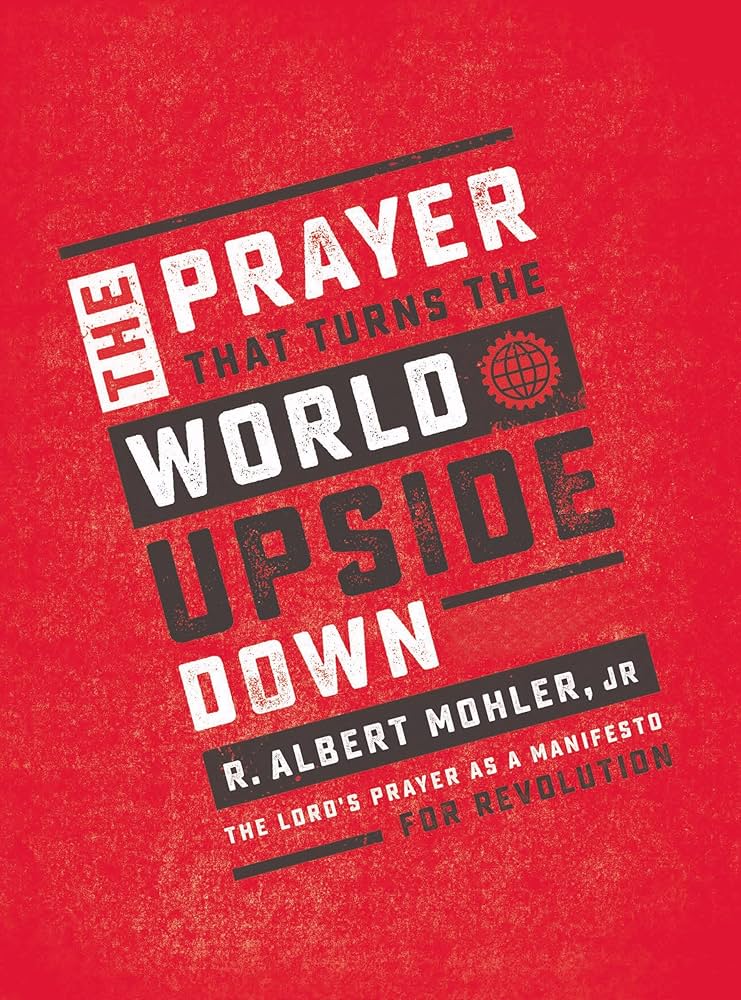
None other than Jesus Himself taught His people to pray—a remarkable truth. Because He is fully God and fully man, Jesus is the only one truly qualified to teach us how to pray.
Jesus engaged in and experienced a life of prayer. Because He lived without any taint of sin, Jesus led a life of perfect prayer.
There is No “I” in Prayer: Combating Individualism in Our Prayers
Over the past several decades, many Christians tend to begin their prayers by presenting their needs. Our circumstances and trials are often the very things that drive us to pray in the first place.
As a result, our prayers, from beginning to end, are often marked by petition.
Jesus begins by identifying the character of the God to whom He prays while at the same time challenging our individualism in prayer. Jesus does all this in the first two words, “Our Father.”
Do you notice what is stunningly absent from the Lord’s Prayer? There is no first-person singular pronoun in the entire prayer!
The point is not to deny our own sins and our own needs, but to never leave the focus solely on ourselves. One of the besetting sins of evangelicalism is our obsession with individualism. The first-person singular pronoun reigns in our thinking.
Many of us falter in prayer because we begin with the wrong word: I instead of our. Jesus reminds us that we are part of a family, even when we pray. Thus the first word of Jesus’ model prayer is the word our. We are in this together.
A Father in Heaven: Our Imminent and Transcendent God
God is identified by many titles throughout Scripture. He is called “Lord,” “Most High,” “Almighty,” “King,” and even “the judge of all the earth.” Yet in the Lord’s Prayer, Jesus does not refer to God by any of those titles. Instead, Jesus refers to Him as “Father.”
Jesus is here affirming a filial relationship that exists between the Creator and those who have been saved through faith in Jesus Christ and adopted into God’s family.
Scripture affirms that we only come to know God as our Father personally when through faith in Christ we are adopted into God’s family.
Scripture is unambiguous. We can only relate to God as Father because we have received the Spirit of adoption as sons and daughters through the objective, atoning work of Jesus Christ.
The Prayer Course with Pete Greig

Jesus teaches us to address our prayer to “Our Father.” We start our prayer with worship. Worship puts things back in perspective.
Think about when we stare at the stars. We are easily amazed at God’s creation. Remember that God is God, He is holy, He is our Father, who loves us.
It’s easy to obsess about ourselves—how we’re feeling and what we’re thinking. Therefore, it’s a good idea to start our prayer life with adoration. Adoration is coming to the Father not to get something from Him but to give something to Him. It’s about being, not doing. It’s about intimacy and presence.
The Book of Common Prayer (1662) says, “Adoration is the lifting of the heart and the mind to God, asking nothing but to enjoy God’s presence.”
We need to remember that God is relational—not transactional. God invites us to enjoy Him and His presence.
Do that today, and start your prayer with those two simple words, “Our Father.”