
Click here to return to Blog Post Intro
The Lord and His Prayer by N.T. Wright

Testing, temptation, and trial marked out Jesus Christ’s entire public life. He went straight off after his baptism, to wrestle with the huge and awesome implications of his newly-confirmed vocation.
Gethsemane suggests the deepest meanings of the prayer: “Do not let us be led into the Testing, but deliver us from Evil.” Again and again, Jesus says to his followers, “Watch and pray, that you may not enter into Temptation.”
The word “temptation” here means “testing” or “tribulation.” The great tribulation, the birth pangs of the new age, the moment of horror and deep darkness, is coming swiftly towards him. And in his own moment of agony he fears, with good reason, that the whirlpool of evil which is to engulf him will suck down his close followers as well.
Where Jesus goes, the rest of us cannot follow. The rest of us are therefore commanded to pray that we may be delivered from the power of Evil.
What, then, is evil, and how are we delivered from it? There are three possible wrong answers:
The first is the head-in-the-sand approach. You can pretend that evil doesn’t really exist, or that, if it does, it doesn’t really matter.
The second answer, the mirror-image of the first, is to wallow in evil, and to see it all over the place.
The third answer is that of self-righteousness. “Lord, I thank you that I am not as other people.” Yes, we say, evil is out there all right; but we are the righteous ones, the holy ones, called to leap on our white chargers and ride off to do battle with it. But what if self-righteous battles are themselves another manifestation of evil?
In Jesus’ day, the first approach (minimizing evil) was that of the Sadducees; the second (wallowing in the fact of evil) was that of the Essenes; and the third (the zealous fight against evil) was that of the Pharisees.
Jesus intends his followers to recognize not only the reality of evil but the reality of his victory over it. We need to examine both sides of this balance.
Evil is real and powerful. Satan, the Accuser (“The Satan” or “The Evil One”) is not equal and opposite to God; but “he” or “it” is a potent force, opposed to God’s good creation, and particularly to the human beings whom God wishes to put in authority over his world. If all of this were not so, the final petition in the Lord’s Prayer would be an unnecessary anti-climax.
But Jesus’ victory over evil is also real and powerful. To pray “deliver us from evil” or “from the evil one” is to inhale the victory of the cross, and thereby to hold the line for another moment, another hour, another day, against the forces of destruction within ourselves and the world.
Do not let us be led to the Test! Deliver us from Evil!
This is part of the prayer for the Kingdom: it si the prayer that the forces of destruction, of dehumanization, of anti-creation, of anti-redemption, may be bound and gagged, and that God’s good world may escape from being sucked down into their morass.
Deliver us from the horror of war! Deliver us from human folly and the appalling accidents it can produce! Let us not become a society of rich fortresses and cardboard cities!
Save us from arrogance and pride and the awful things they make people do! Save us—from ourselves…and Deliver us from the Evil One.
You can only pray these prayers when you are saying Yes to God’s Kingdom coming to birth within you. When you are saying Yes to the call to follow Jesus to Gethsemane, even when you don’t understand why; when you are saying Yes to the vocation to go to the place of pain, to share in the name of Jesus, and to hold that pain prayerfully in the presence of God who wept in Gethsemane and died on Calvary.
We are called to live and pray at the place where the world is in pain, so that the hopes and fears, the joy and the pain of the whole world may become, by the Spirit and in our own experience, the hope and fear, the joy and pain of God.
By giving us this prayer, then, Jesus invites us to walk ahead into the darkness and discover that it, too, belongs to God. If we have the Lord’s Prayer on our lips when darkness breaks, it will be (not mere good cheer, but) glory itself that wakes—the hope and promise that God will triumph over fear, will deliver us from evil, and will bring in his Kingdom at last.
The Prayer Course by Pete Grieg

The Bible is clear that we are in a spiritual battle with an enemy. The Apostle Peter says, “Be alert and of sober mind. Your enemy the devil prowls around like a roaring lion looking for someone to devour” (1 Peter 5:8). Paul writes that believers do not struggle against “flesh and blood,” but against rulers, authorities, cosmic powers, and spiritual forces of evil (Ephesians 6:12). Spiritual battle is a Biblical reality, and we all know the daily battles of all kinds of spiritual attack.
In the first century, Jesus faced three different spiritual worldviews:
- The Sadducees were sophisticated, political maneuverers, who didn’t believe in angels or demons. For them, the Kingdom of God was a socio-political reality. They would have eliminated this last line of the prayer.
- For the Essenes, everything was super-spiritual. Where Sadducees minimized spiritual warfare, the Essenes wallowed in it. Everything was about the battle.
- The Pharisees represented the middle ground because they believed in angels, demons, heaven, and hell. They also believed the way you overcame the enemy was to live a radically righteous and holy life by following a list of 613 rules.
Most people fall into one of these three categories or caricatures, and Jesus challenged all three of these worldviews. A Biblical worldview combines a sober recognition of the reality of spiritual warfare with an earthly dose of good humor and common sense.

We need to recognize the reality of spiritual warfare but keep our focus on Jesus Christ. Consider the Armor of God that Paul outlines in Ephesians 6:10-18. Everything in the Armor—other than the shoes of the gospel are defensive weapons.
In prayer, you’re taking seat in heavenly places to advance His Kingdom.
In spiritual warfare, we need to:
- Pray It
- Practice It
- Preach It
A Layman Looks at the Lord’s Prayer by W. Phillip Keller

In various translations, this phrase is rendered, “But deliver us from the evil one,” or “Save us from the evil one.”
There is a tendency for us to think of sin, self (or self-will), and Satan as being more or less widely separated from each other. In fact the three are so closely intertwined that they cannot be readily divorced from each other.
Satan influences us to exert our wills in contradiction to the expressed will of our heavenly Father. This is to sin. Because of this, Christ taught us to pray emphatically, “Deliver us from evil [from the evil one].”
Our Father does not want to see us succumb to temptation. He does not want to see us fall. He wants us, as His maturing children, to grow up in strength so we can walk serenely with Him in the beauty of a strong, unsullied, intimate companionship.
We need to remind ourselves, too, that no matter how often or hard we fall, He is there, waiting to pick us up and restore us. Why? Simply because we are His children, because He loves us, and because He knows that only as we go on do we grow up into His likeness.
Our struggles with sin and self and Satan, seen this way, are not the terrible trials we generally think them to be. Instead they are challenging, testing encounters that can strengthen our determination to go on with God. They inspire within us the resolve to mature into strong men and women with whom our heavenly Father loves to associate.
There are three definite, simple, and positive ways by which our heavenly Father delivers us from the evil one:
- He is always there. He is always available.
- He endows us, by His Spirit, with spiritual common sense which he expcts us to use in avoiding temptation.

The Scriptures are replete with stirring accounts of men and women who positively refused to be caught in any compromising situation where they could be enticed by evil. They firmly determined that they would not, if they could help it, be in places or with people where they would be vulnerable to the evil one.
- He gives us the ability to battle it.
In James 4:7, we are told very clearly, “Resist the devil, and he will flee from you.” There is a sense in which God expects His children to be brave and bold in counterattacking Satan. Far, far too often we give ground to the enemy of our souls without any resistance. We simply slide into sinning without a struggle. This should not be.
The Spirit which God has given to us is not the spirit of fear, but rather of power and of love and of a disciplined mind (2 Timothy 1:7).
We live in an age where it is commonplace for many Christians to attribute many of their trials and troubles to the evil one. In part, this may be true. But as God’s children we should give him less credence than many do.
Satan has no claim upon God’s children, nor does he have the power to tempt or tantalize them, except by express permission from our Father in heaven. “We know [absolutely] that anyone born of God does not [deliberately and knowingly] practice committing sin, but the One Who was begotten of God carefully watches over and protects him [Christ’s divine presence within him preserves him against the evil], and the wicked one does not lay hold (get a grip) on him or touch [him]” (1 John 5:18).
Never, ever forget that out of what seems to be evil, God our Father can and does bring great good to His children.
“Now to him that is able to keep you from falling, and to present you faultless before the presence of his glory with exceeding joy, to the only wise God, our Savior, be glory and majesty, dominion and power, both now and ever. Amen” (Jude 24-25).
The Prayer that Turns the World Upside Down by Dr. R. Albert Mohler, Jr.
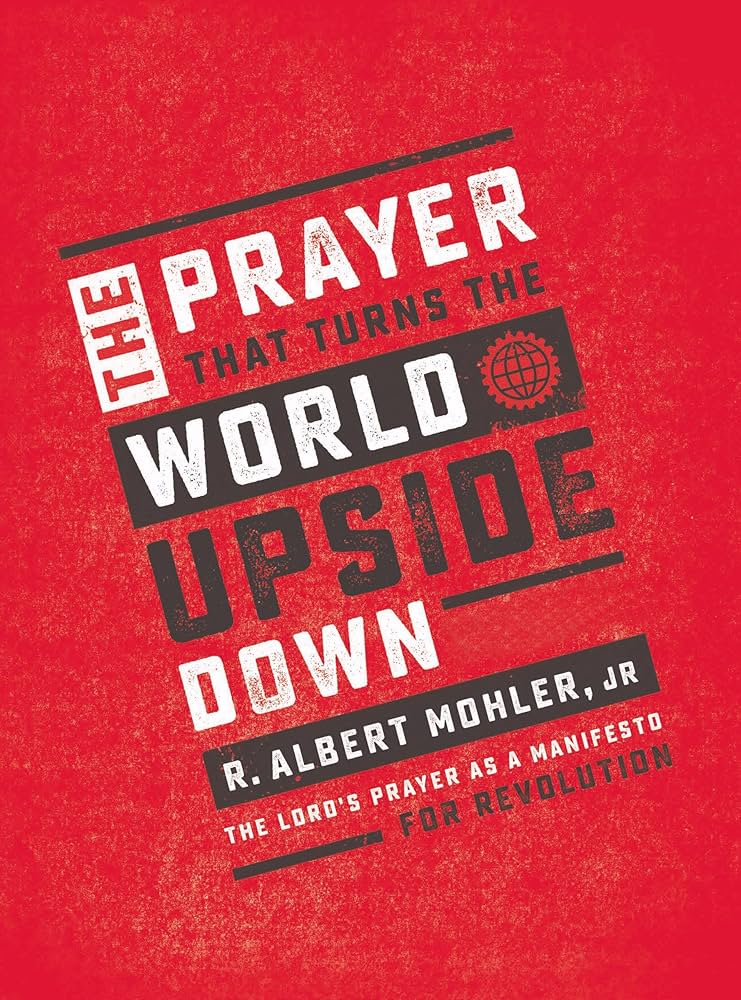
While the final petition of the Lord’s Prayer is typically rendered, “Deliver us from evil,” most modern scholars and translations note that the most appropriate translation is probably “deliver us from the evil one.” In other words, this is not just evil as some inanimate force, but a personal evil being—the Devil.
We may never make real strides against temptation until we learn our need to pray this petition. Only as we recognize that our struggle with sin is not only internal but external as well, will we be able to heed with any urgency the words of James.

Jesus taught his disciples that the best weapon against temptation is prayer. When we do not pray faithfully, our defenses are down. Thus, the tempter has his opportunity. In the heart lacking prayer, Satan easily sows seeds of temptation.
Fighting the Powers of Darkness in the Life of the Church
As Paul noted, when we are delivered from Satan’s clutches, we are transferred out of the kingdom of darkness into the kingdom of God’s dear son (Colossians 1:13). But note, we are transferred into a kingdom—a kingdom made visible by local congregations who gather in the name of the Lord to share in one another’s lives and in the work of the ministry. This is why Jesus teaches us to pray in the plural, “deliver us from evil.”
Every Christian church is supposed to be a deliverance ministry. Christians are in this together. Together, we hear the Word of God, pray, sing, take the Lord’s Supper, celebrate baptism, and hold one another accountable. The Lord uses the local church made up of Christians walking in holiness to keep his people from temptation, sin, and the power of the evil one.
Temptation comes to individuals, churches, and institutions. We know the power of temptation by looking in both history books and the mirror. If we are honest with ourselves, we are not up to the task. But Jesus teaches us that we have access to deliverance from sin and temptation by the grace and mercy of God, which is why we must repeatedly pray this prayer of deliverance.