
Click here to return to Blog Post Intro

A Layman Looks at the Lord’s Prayer by W. Phillip Keller

Would God lead anyone into temptation?
It is well for us to remind ourselves that when Jesus Christ taught His disciples this prayer, He Himself had already been through very severe temptation. We are told that after His baptism in the Jordan, “Then was Jesus led up of the Spirit into the wilderness to be tempted of the devil” (Matthew 4:1).
He included this petition in the prayer out of compassionate concern for His followers. He shrank from seeing us exposed to the sort of temptation that He Himself had endured.
Jesus cautioned the eleven disciples who accompanied Him to the garden, with these words:

It is tremendously important to bear in mind that though temptation to evil is essentially a spiritual struggle that involves our wills, it is almost always fought in the realm of our personal passions (desires).
Satan’s Subtle Points of Approach to my Person are Through
- My Emotions (e.g., self-pleasure or self-indulgence). Christ was tempted to make bread from stones.
- My Mind (e.g., my reason, which includes self-preservation and self-reasoning). Christ was tempted to cast Himself off the Temple.
- My Will (e.g., My ego, self-prominence, and self-assertion). Christ was tempted to accept an offer of world empires.
To assert that it is God who allows this temptation to go on is to fail to understand the whole nature of temptation. James, in his usual very practical and pragmatic way, explains temptation this way:
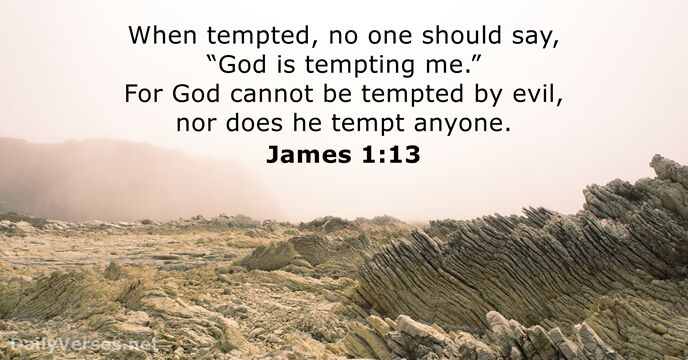
It is well to remind ourselves, always, that He does not allow us to be tempted above or beyond that which we are able to endure or bear (1 Corinthians 10:13; Hebrews 2:18).
There are six steps which lead to defeat in temptation:
- We are given a false impression by Satan that whatever wrong we do is really not that serious.
- Satan makes us see (either in fact, or in our minds) something, someone, or some situation which he is sure will appeal to our self-life. In other words, he presents a picture to us that arouses some passion or desire in our personality.
- Unless we understand his tactics, this produces a powerful response within us, arousing a deep and compelling desire.
- We begin to toy with the idea. We entertain it and play with it. It appeals increasingly, so we finally reach out to take it.
- We proceed to act on that which was presented to us in such a subtle, skillful manner.
- We hide our defeat, attempting to excuse or conceal the debacle from others and from God.
Temptation itself is not necessarily an evil experience. It is part and parcel of our Father’s plan for producing people of strong character and Christlike qualities.
It is perfectly proper and legitimate for us to ask our Father in heaven not to lead us into temptation, simply because we know our hearts and their natural propensity to evil. Still, He has made provision for us to be triumphant in temptation. He is able to deliver us from evil!
The Lord and His Prayer by N.T. Wright

Testing, temptation, and trial marked out Jesus’ entire public life. He went straight after his baptism to wrestle with the huge and awesome implications of his newly-confirmed vocation.
Gethsemane suggest the deepest meanings of the prayer, “Do not let us be led into the Testing.” Again and again, Jesus says to his followers: Watch and pray that you may not enter into Temptation.
Now, it would be absurd to suppose, at that moment of all moments, that Jesus was telling his followers to say their prayers in case they might be tempted to commit some trivial personal sin. No, the word “temptation” here means “testing” or “tribulation.” The great tribulation, the birth pangs of the new age, the moment of horror and deep darkness, is coming swiftly towards him. And in his own moment of agone he fears, with good reason, that the whirlpool of evil which is to engulf him will suck down his close followers as well.
The Prayer that Turns the World Upside Down by Dr. R. Albert Mohler, Jr.

We like to think the world is a safe place, but it is not. We like to imagine that evil is distant, but as the headlines reveal, evil is always lurking near. If we are honest, we know that danger can crop up in any circumstance.
The Bible clearly teaches that the Devil and his demons are real and that these invisible enemies are bent on destroying our spiritual lives.
Jesus’ final petition reminds us that we have a daily fight against principalities and powers: “lead us not into temptation…”
Why We Need This Petition
Jesus’ reminder to pray regularly against temptation reminds us just how prevalent and dangerous the appeal of sin can be in the Christian life.
As the story of Cain reminds us, sin doesn’t want to play a minor role in our lives; it wants to “rule” over us (Genesis 4:7).
This petition also reminds us of several other very important points:
- Christians must recognize that temptations are real and a daily threat to communion with God and life with Christ. The most dangerous thing a Christian can ever do is believe that he is somehow immune to temptation.
- We are not able to resist temptation by our own power. The gospel and this petition in the Lord’s Prayer turn our attention away from our own strength to the strength of another. Jesus’ words “lead us not into temptation” express a heart of dependency, not self-sufficiency.
- Christians must pray for endurance in the fight against temptation. Christians should pray this petition as well as pray for the grace to overcome temptation all the way to the grave.
Does God Lead People Into Temptation?
When Jesus prays “lead us not into temptation,” he is not asking God to act in a way contrary to his nature, but in a way entirely consistent with his holiness. Jesus is asking God to lead him away from evil and away from the lusts of his own flesh.
We must recognize that while God will never tempt us, he may sometimes test us in order to strengthen our faith. As James wrote, “Count it all joy, my brothers, when you meet trials of various kinds, for you know that the testing of your faith produces steadfastness. And let steadfastness have its full effect that you may be perfect and complete, lacking in nothing” (James 1:2-4). So God does test us, but he does not seek to tempt us into sin.
The petition “lead us not into temptation” makes several important theological points:
- We must recognize that temptations are a real, daily threat to our lives with Christ.
- We must understand that we are not able to resist temptation by our own power. Apart from God, we are simply unable to resist temptation.
- We must pray for endurance in the fight against temptation.
- We must pray that the Lord delivers us from our own personal patterns of temptation.
As James wrote in James 1:14-15, “Each person is tempted when he is lured and enticed by his own desire. Then desire when it is conceived gives birth to sin, and sin when it is fully grown brings forth death.” As this passage makes clear, temptation emerges from inside our hearts when we are carried away by our own desires. Unless we fight against these sinful desires, these internal temptations turn into outward sins. Pride leads to arrogance. Lust leads to sexual immorality.
Temptation comes to individuals, churches, and institutions. We know the power of temptation by looking in both history books and the mirror. If we are honest with ourselves, we are not up to the task.
Jesus teaches that we have access to deliverance from sin and temptation by the grace and mercy of God, which is why we must repeatedly pray this prayer of deliverance: “lead us not into temptation…”