
Click here to return to Blog Post Intro
Petitionary Prayer from The Prayer Course by Pete Grieg

When we pray, it’s easy for us to understand how we can change but it’s harder for us to imagine that we can impact things around us.
Most people believe in the power of prayer. Any group of Christians will share personal testimonies of how God answered prayers. Jesus says, “If you ask anything in my name, it will be done for you” (Matthew 7:7). It’s prayer in line with his character and purposes.
The Greek here is “keep on asking…keep on seeking…keep on knocking…” and it will be opened. God is your Father, and He wants to bless you.

Image by Andreas Fröhlich from Pixabay
Pete uses the traffic light analogy to describe different ways God responds to our prayers:
- Green: Yes
- Yellow: Wait
- Red: No (this can be agonizingly painful… Pete’s wife battles chronic illness… These are the times to hold on to God’s love. Don’t give up on God’s love. Don’t doubt God’s love.)
Practical Steps You Can Take
- Pray with others.
- Learn to pray incrementally.
- Learn to pray God’s promises.
- Pray consistently.
Don’t just pray once or twice. Sometimes we need to “stack dominoes” and persevere in prayer. Maybe it’s because we’re praying for something bigger than we even realize. Eventually, you may get the breakthrough you’re looking for.
The Prayer that Turns the World Upside Down by Dr. R. Albert Mohler, Jr.
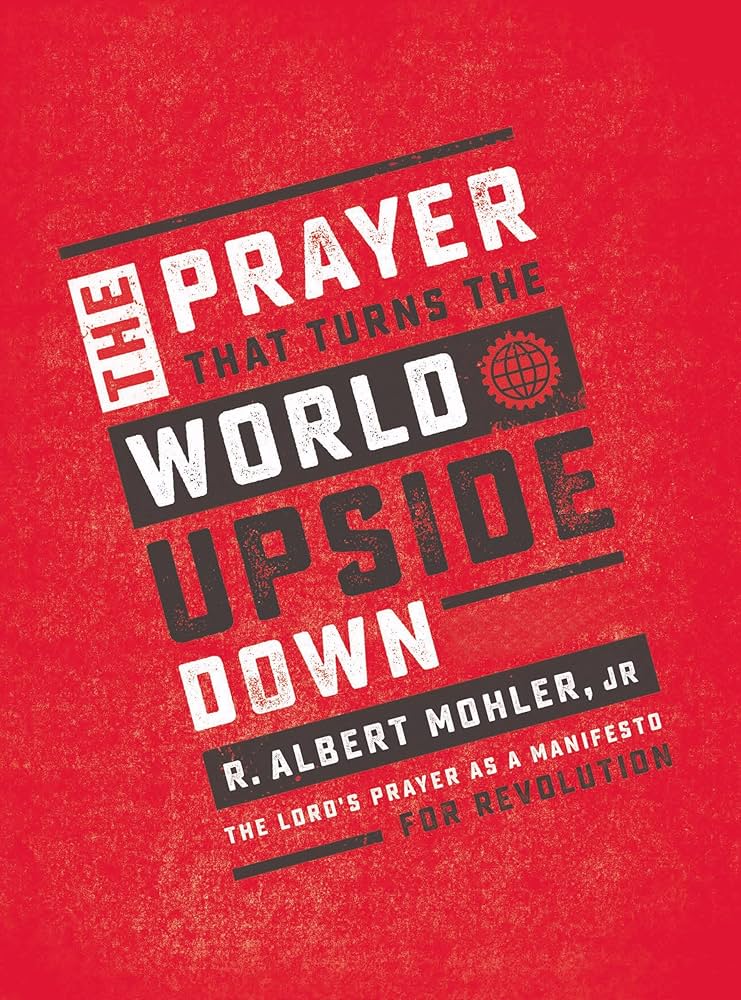
Up to this point, the Lord’s Prayer has revealed a great deal about the character of God.
Jesus’ subsequent turn to consider our own needs—“Give us this day our daily bread”—serves as a clear and unmistakable reminder that we are merely creatures; God is the creator. We are needy; God is the provider.
Martin Luther once reminisced that our physical needs remind us that we are but creatures composed of dirt. Our lives are frail, fragile, and wholly dependent on the goodness of God.
Physical Needs in Biblical Perspective
We are dependent on God.
Even though Adam and Eve were dependent before the fall, their only experience was one of surplus and abundance. Our default experience is no longer abundance but scarcity.
We are no longer creatures in need of provision; we are sinners in need of the Creator’s mercy.
The Dignity of the Body and of Physical Needs
Jesus’ focus up to this point in the Lord’s Prayer has been on the greatness and grandeur of God, yet with the words “give us this day our daily bread,” He moves from the clouds of heaven to the trials and troubles of our own dusty streets and dirty kitchens.
Regrettably, we often do not recognize just how dignified our physical needs are until we witness true deprivation and scarcity.
Jesus dignifies our physical needs by teaching us to petition God on matters as seemingly insignificant as the food on our plate.
Samuel Johnson once said, “He who would deny the stomach will soon be thinking of nothing but the stomach.” As we all know, the more we try to deny the necessity of food, the more urgent the need becomes.
Food, rightly received, functions as a constant reminder of the greatness of God and our need for His goodness and provision.
Further, this word teaches us to pray for our needs every day, seeking God’s provision in our life hour by hour. In sum, the word daily here teaches us to train our hearts to depend consistently on God, rather than just in times of need.
We may never experience great riches, but we can be confident that God will provide for us—through sometimes his perception of what we most need may be different from our own.
Bread of Earth, Bread from Heaven: Echoes of Eternity in Jesus’ Petition for Bread
This request reminds us of our daily need for the Lord Jesus. Moses reminded the Israelites in Deuteronomy 8:3 that the reason God let the Israelites go hungry for a time before providing them with manna was so that they might learn that “man does not live by bread alone, but man lives by every word that comes from the mouth of the Lord.”
God designed physical needs to point to our deeper spiritual needs.
This is why Jesus regularly referred to Himself as the “bread of life,” the true manna sent from heaven (John 6:35). He is God’s ultimate provision for our spiritual lives.
Each time we pray for daily bread, we should recognize our deeper need for the bread of life—the only one who can truly satisfy.
A Layman Looks at the Lord’s Prayer by W. Phillip Keller

It should not surprise us unduly that Christ should include in this great prayer a request for food. It is, after all, the very basis of our existence. This applies whether we are dealing with the physical or spiritual aspects of our lives.
Jesus teaches us that the natural resources of the earth are supplied for us by God our Father. They are more than adequate to meet our basic needs. Just as He provides for the wild birds and the wildflowers, so He has provided enough for us.
Also, He would have use understand that all the many resources put at our disposal are really gifts from God. In James 1:17, we are told, “Every good gift and every perfect gift is from above, and cometh down from the Father of lights.”

Putting all this into rather simple layman’s language, we might state it this way: Any man or woman prepared to put God’s wishes first in life is bound to have bread.
Perhaps it is natural for us to take our daily food for granted.
For those who have lived abroad where poverty, starvation, famine, begging, and horrible hunger are a way of life, this petition is full of meaning. For uncounted millions of men and women, there is no assurance whatever that there will be bread today, much less bread tomorrow. They may not have had bread yesterday or the day before that.
One of the very practical ways in which we can help to make this prayer much more than just a pious platitude is in helping to share and distribute the bounty given to us with others. This is part of feeding the hungry and giving water to the thirsty, which Jesus pointed out to be of such importance to God’s estimation.
As has been reiterated in God’s Word, “Man shall not live by bread alone, but by every word that proceeds out of the mouth of God” (Matthew 4:4; Luke 4:4). The amazing thing is that this statement was first made by Moses (Deuteronomy 8:30 to a nation whom God had supplied with manna day after day, during all their years of wilderness wanderings.
For, just as God our Father is the Author and giver of all temporal benefits bestowed upon us, so He is likewise the giver of spiritual sustenance. Jesus made this clear when He stated, “My Father gives you the true bread from heaven” (John 6:32).
Our Lord made it very clear that to come to Him was to eat spiritual bread. As with manna and so with Him, we have to come regularly., daily, to derive nourishment afresh from God.
It is a deep, desperate yearning to have the risen Christ made real in me each day. “Oh, Father, give me this day my daily bread!” “Oh, Father, let the very life of Your resurrected Son, my Lord the risen Christ, become my life today!”
Such a petition, such a prayer, such a desire could and does originate only with God Himself. It is not the sort of thing to spring from any self-centered, self-satisfied heart. Marvel of marvels, Christ Himself promised that anyone who so hungered would be filled (Matthew 5-6).
The “daily bread” on which I feed will bring about subtle yet profound changes in my personal lifestyle. After all, it is Christ Himself who, by His Spirit, is permeating my whole being.

If we feed our souls and spirits on God’s bread from heaven, it follows that this is what we shall become. This is a powerful principle. It explains why the Master included this apparently earthly petition in His noble prayer.
The Lord and His Prayer by N.T. Wright

If we don’t spend time adoring our Father in heaven, seeking the honor of His name, and praying for His kingdom, all our own desires and hopes will simply present themselves to us in a muddled and jumbled fashion, coming bubbling up to the surface.
Consider what to do with the muddled jumble or the stream of consciousness. Clear your mind to pray, and what do you find? A buzz of fears and hopes and wants and puzzles; behind that, perhaps, some deep sadness; some real anger and some real joy, some true delight.
Jesus warns His hearers not to spend all their energy working simply for the food which perishes, but to strive instead for the food which lasts to eternal life. But He doesn’t make this point by denying them food for the stomach; He provides for them at that level, and points, through that, to a deeper provision for deeper needs and desires. In His knowledge of their needs, for bread and all else besides, is no threat, but only promise.
The prayer Jesus gave His followers was a prayer for the complete fulfillment of His Kingdom: for God’s people to be rescued from hunger, guilt, and fear.
Scripture is full of stories of people who brought their deep natural longings into the presence of God and found them answered by being taken up within His purposes.
The Greek for “give us this day our daily bread” is tricky, but Matthew seems to mean “give us today our bread for tomorrow.” Luke seems to be saying, “Give us each day our daily bread.” They both reflect different aspects of what Jesus intended. Matthew, in line with Jesus’ whole agenda, means “give us, here and now, the bread of life which is promised for the great Tomorrow.”
Matthew, writing in his gospel, saw this prayer partially answered in the feedings of the five thousand and the four thousand; more fully in the Last Supper; and most fully of all, in Jesus’ death and resurrection.
Luke’s version is pointing to the Kingdom coming on earth as it is in heaven. Daily needs and desires point beyond themselves, to God’s promise of the kingdom in which death and sorrow will be no more.
This clause of the prayer becomes a window on four central issues in our own praying:
- “Give us this day our daily bread”: this clause in the Lord’s Prayer reminds us that our natural longings for bread and all that it symbolizes, are not to be shunned as though they were of themselves evil. Since God Himself is most truly the deepest object of our hunger, this clause asks that we may be fed with God Himself.
- This clause reminds us that God intends us to pray for specific needs.
- We must lift our eyes beyond our own needs. It is impossible truly to pray for our daily bread, or for tomorrow’s bread today, without being horribly aware of the millions who didn’t have bread yesterday, don’t have any today, and in human terms are unlikely to have any tomorrow either. We should be praying this prayer not just for the hungry, but with the hungry, and all who are desperate from whatever deep need.
- All of these aspects of prayer come together when we meet around the Lord’s Table, when the power of the Spirit bread and wine become the vehicles and vessels of God’s own love in Jesus Christ.
The next time you come to the Lord’s Table, bring with you, in mind and heart, someone you know, or know of, or have seen, who desperately needs God’s bread, literally or metaphorically, today. Bring them with you; let them kneel, in your mind’s eye, with you at the altar rail; and let them share the bread and wine with you. And, as you return, strengthened by God’s food, ask yourself what this new friend would mean when she or he prays “Give me this day my daily bread.” Then ask how you might be part of God’s answer to that prayer.